
You pour cold milk into a frother, wait half a minute, and end up with a thin raft of bubbles that disappears before the cup reaches the table. The frother is usually fine. The milk is the variable most people overlook. Protein builds the bubble walls, fat either enriches the texture or tears those walls down, and added oils and stabilizers decide whether a plant milk behaves like dairy or collapses into dishwater. Equipment matters too, and if you are still sorting out hardware, firstgradeappliances.com covers affordable countertop frother options worth knowing about. This guide explains what each milk actually does in the pitcher.
Quick Answer
Foam quality depends mainly on protein and fat. Skim milk produces the stiffest, driest dairy foam because it has plenty of protein and almost no fat to destabilize bubbles. Whole milk foams slightly less stiffly but tastes creamier. Among plant milks, soy and barista-style oat blends foam best, while plain almond and coconut beverages usually foam poorly unless they are specifically formulated with added oils and stabilizers. Temperature matters as much as milk type: steaming above roughly 70°C (158°F) breaks down foam regardless of what is in the pitcher.
Key Takeaways
- Protein forms the bubble structure; without enough of it, foam collapses quickly no matter how hard you froth.
- Fat adds flavor and body but weakens foam stability, which is why skim milk gives stiffer foam and whole milk gives softer, richer microfoam.
- Soy milk and barista-formulated oat milk are the most reliable plant-based options because of their protein content and added oils.
- Plain almond and coconut beverages are the weakest frothers unless labeled “barista” or “foamable.”
- Overheating is the most common cause of failed foam, so stop steaming before the pitcher becomes uncomfortable to hold.
Why Milk Type Changes Foam in the First Place
Milk foam is a network of air bubbles wrapped in a thin film of liquid. That film needs two things to hold: proteins that arrange themselves around each bubble and create an elastic skin, and enough viscosity to slow drainage as gravity pulls liquid down. Casein and whey proteins do this job well in dairy milk. When you introduce heat and air, these proteins unfold and link together at the air-liquid boundary, which is what gives steamed milk its structure.
Fat works against that process. Fat globules are hydrophobic, meaning they repel water, and they tend to push into the bubble membrane and disrupt the protein film. A small amount of fat adds richness and a silkier mouthfeel. Too much fat and the bubbles merge and pop, which is why heavy cream is difficult to foam into anything lasting.
Sugar, additives, and stabilizers
Plant milks bring a third variable: what the manufacturer puts in the carton. Barista blends typically add sunflower or rapeseed oil, dipotassium phosphate, and gums such as gellan. The oil raises body and mimics dairy fat’s mouthfeel, while the phosphate and gums help the foam hold together under heat. Regular oat and almond milks often skip these additions, which is exactly why they behave so differently from their barista counterparts even though the base ingredient is the same.
How Dairy Milks Compare
If you want the stiffest possible foam for a dry cappuccino, skim milk wins. If you want the best-tasting latte, whole milk usually wins. Everything else sits between those two poles.
| Milk | Approximate fat per cup | Approximate protein per cup | Foam behavior |
|---|---|---|---|
| Skim milk | Under 1 g | About 8 g | Stiffest, driest foam; least creamy flavor |
| 2% reduced-fat | About 5 g | About 8 g | Good balance of structure and body |
| Whole milk | About 8 g | About 8 g | Creamy microfoam, slightly softer peaks |
| Half-and-half | About 28 g | About 6 g | Rich but foams slowly; best for small amounts |
| Heavy cream | About 80 g | About 5 g | Very unstable foam; better as a flavor addition |
These figures are approximate and vary by brand and region, but the pattern holds: protein stays fairly constant across dairy milks while fat climbs sharply. That is why switching from skim to whole changes texture more than it changes foamability.
Ultra-pasteurized versus regular milk
Ultra-high-temperature (UHT) milk has been heated to a much higher temperature than standard pasteurized milk, which extends shelf life. The trade-off is that some whey proteins are already denatured before the milk reaches your pitcher. In practice, UHT milk still foams well, but it can feel slightly different and may taste more cooked. Fresh pasteurized milk tends to give a cleaner flavor in a latte, though it spoils faster.
Lactose-free milk
Lactose-free milk is regular milk with the lactose already broken down into glucose and galactose. The protein and fat content are essentially unchanged, so it foams much like its conventional counterpart. The extra sugars can make foam brown faster when you steam, so keep the steam tip slightly deeper if you notice scorching, When sourcing ingredients and supplies for your cafe, don’t forget to review these 5 factors to consider when selecting coffee packaging.
How Plant Milks Compare
Soy milk is the most dependable plant option because it naturally contains a similar amount of protein to dairy milk. Barista oat milk comes second, largely because of added oils and stabilizers rather than protein. Almond and coconut beverages are the weakest performers in their standard forms.
- Soy milk: Roughly 7–8 g of protein per cup. Foams into a dense, stable microfoam. Flavor is distinct and can compete with lighter roasts.
- Barista oat milk: Around 3 g of protein per cup, but formulated with added oil and stabilizers. Produces creamy, pourable microfoam that works well for latte art.
- Regular oat milk: Same base, no barista additions. Foam tends to be thin and short-lived.
- Almond milk: About 1 g of protein per cup. Foams weakly and often separates into large bubbles.
- Coconut milk beverage: Low protein and high saturated fat. Foams poorly unless a barista version adds protein or emulsifiers.
- Pea and potato protein blends: Increasingly common. Protein content is closer to soy, and foam quality varies widely by brand.
One practical note: plant milks are almost always sold as UHT products, and the heat treatment actually helps them foam by altering protein structure. That is why a carton of shelf-stable soy milk can outperform fresh almond milk from the refrigerated section.
Temperature and Technique: The Variables People Blame on Milk
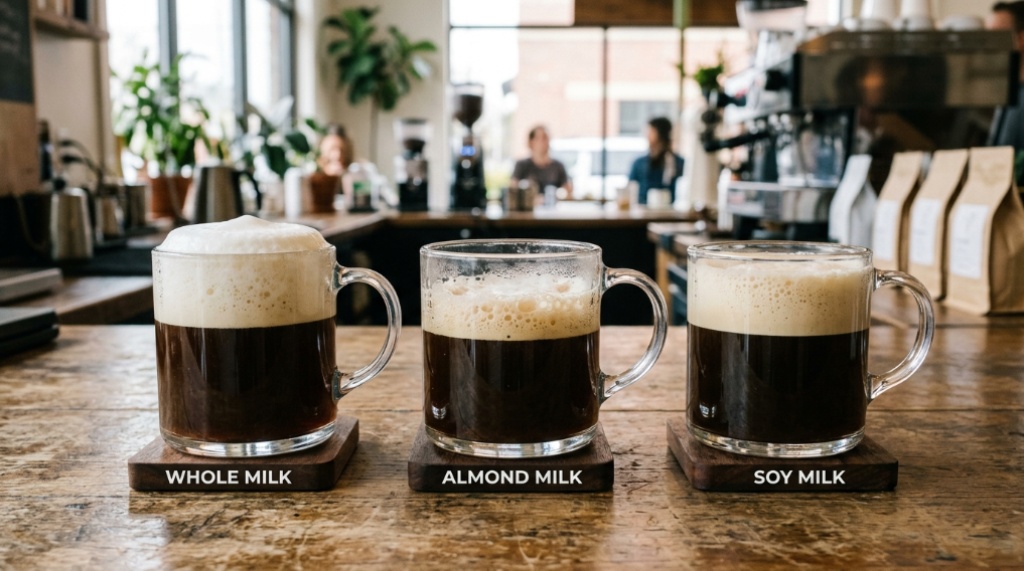
Most “bad milk” complaints are actually temperature problems. Dairy proteins denature usefully between roughly 55°C and 65°C (130°F–150°F). Past about 70°C (158°F), the foam structure weakens and the milk starts to smell cooked. Scalding near boiling destroys it entirely.
- Start with cold milk straight from the refrigerator. Cold milk gives you more working time before it overheats.
- Fill the pitcher no more than one-third full so the milk has room to expand and circulate.
- Introduce air only in the first few seconds, keeping the tip near the surface to hear a short, steady hiss rather than a loud screech.
- Once the volume has grown, submerge the tip deeper to create a rolling vortex that breaks large bubbles into fine ones.
- Stop when the pitcher feels hot but still comfortable against your palm, then swirl and tap before pouring.
Handheld whisk frothers follow different rules. They work best with higher-protein, lower-fat milk because they rely on mechanical agitation rather than steam pressure. Skim milk, soy milk, and barista oat blends respond well. Heavy cream and plain almond milk usually do not.
Common Mistakes That Ruin Foam
Knowing what goes wrong is often faster than learning what goes right. These are the recurring culprits.
- Using milk that is too old. Protein structure degrades over time, and foam quality drops before the milk actually smells off.
- Frothing cold foam in a steam pitcher. Cold foam and steamed foam are different products; a steam wand will not produce the same result.
- Assuming all oat milks are equal. A barista blend and a standard carton can differ dramatically in performance.
- Overfilling the pitcher. Restricted circulation traps large bubbles that never break down.
- Re-steaming milk. Once heated, milk proteins have already changed. A second pass produces flat, lifeless foam.
- Ignoring the carton label. “Barista,” “foamable,” and “barista blend” are meaningful signals, not marketing noise.
Which Milk Should You Actually Use?
The right choice depends on the drink, not on a universal ranking. Match the milk to the outcome you want.
- Dry cappuccino or a thick foam cap: Skim milk, or soy milk if you are avoiding dairy.
- Standard latte with silky microfoam: Whole milk or 2% for dairy drinkers; barista oat or soy for plant-based.
- Flat white: Whole milk, which gives the richer texture the drink is built around.
- Iced latte with cold foam: Skim milk or barista oat, frothed cold rather than steamed.
- Dessert-style drink: Whole milk with a small splash of half-and-half added after frothing, not before.
- Dairy-free and nut-free: Soy or pea-protein blends, which foam more reliably than oat in most cases.
If you drink multiple styles, keep two cartons on hand: one skim or 2% for foam-heavy drinks and one whole or barista blend for texture. That single change solves more foam problems than any upgrade to your equipment.
Frequently Asked Questions
Does whole milk or skim milk foam better?
Skim milk foams better in the structural sense. It produces stiffer, longer-lasting foam because it has the same protein content as whole milk with almost none of the fat that destabilizes bubbles. Whole milk gives a creamier, softer foam that many people prefer for taste.
Why does my oat milk foam disappear so fast?
Standard oat milk is low in protein and usually lacks the added oils and stabilizers found in barista versions. Without those, the bubble walls drain and collapse quickly. Switching to a barista blend or adding a small amount of soy milk usually fixes it.
Can you foam almond milk?
You can, but the result is usually thin and short-lived. Almond milk contains roughly 1 g of protein per cup, which is not enough to build a stable bubble network. Barista almond blends with added protein or emulsifiers perform noticeably better.
Is barista oat milk worth the extra cost?
For anyone making lattes or cappuccinos regularly, yes. The added oils and stabilizers are the reason it foams at all, and the difference in texture is immediately obvious. For occasional use, standard oat milk is acceptable if you are not chasing latte art.
What temperature should milk be when frothing?
Aim to finish between roughly 55°C and 65°C (130°F–150°F). Below that range the foam is underdeveloped; above it the proteins over-denature and the foam turns flat and the milk tastes cooked.
Does lactose-free milk foam differently?
Not meaningfully. Lactose-free milk has the same protein and fat profile as regular milk, so it froths similarly. The only practical difference is that its added sugars can cause slightly faster browning if the milk gets too hot.
Conclusion
Foam is a protein story with a fat complication. Skim milk gives you the stiffest structure, whole milk gives you the best flavor, and soy or barista oat milk covers most plant-based needs. Plain almond and coconut beverages will disappoint unless they are specifically formulated for frothing. Before blaming your equipment, check your milk’s protein content, whether it is a barista blend, and how hot you are steaming it. Fix those three variables and most foam problems resolve on their own.